
女生怒撕港独标语
终年66岁!意大利传奇巴雷西离世!再见米兰6号_我的网站

A |
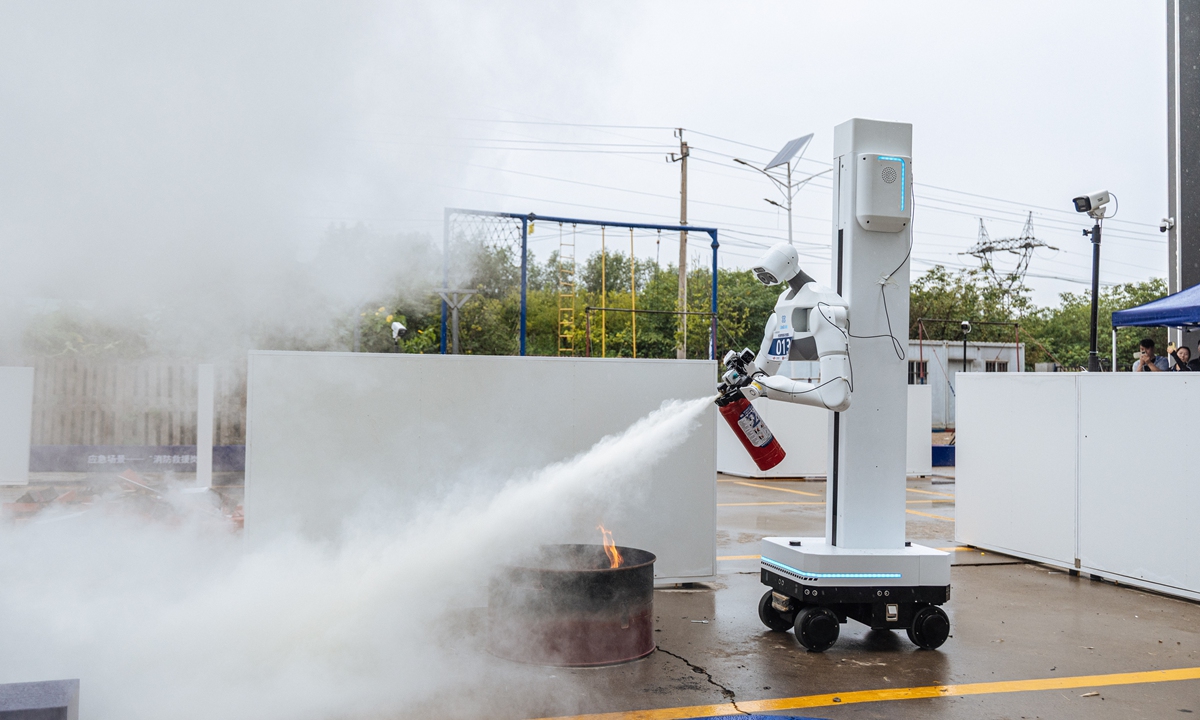
The firefighting final of the emergency management category at the 2nd World Humanoid Robot Games (WHRG) was held on Sunday in Beijing, putting 23 teams through a simulated rescue operation designed to test whether humanoid robots can move beyond demonstrations and perform practical tasks in complex real-world environments.
The event comes as Chinese humanoid robots, long known for eye-catching abilities such as running, dancing and music playing, are pushed toward practical applications, including jobs that are dangerous for humans such as emergency rescue.
Unlike the first edition of the WHRG last year, according to the organization committee, this year's scenario-based events emphasize "realistic simulation," with the firefighting competition being held at a fire brigade rather than in a model-room setup.
The competition simulated a firefighting assignment that required each of the 23 robots to complete three tasks within 30 minutes: identify hazardous materials, shut off valves and operate a fire extinguisher. For the first task, robots had to identify two randomly placed simulated hazardous substances and report their types to judges through returned images. They then had to locate three randomly selected open valves of different types and shut them off before identifying a fire source, finding a fire extinguisher and spraying it until the fire was put out.
Human firefighters were also involved in the event, lighting the fire and observing whether the robots carried out the extinguisher operation correctly.
The competition, however, showed how difficult it remains for robots to perform reliably outside controlled laboratory conditions.
Rain affected the competition, while changes in lighting and the outdoor environments added uncertainty to the robots' visual recognition and manipulation tasks. A team from UniX AI, a company well-known for its robot applications on real-world scenarios and has just raised a new round of 300 million yuan ($ 44.49 million) in late March, completed its run within the allotted time, but its robot moved relatively slowly compared to human firefighters' real practice. When operating the fire extinguisher, its robotic hand had to make two attempts to align with the target.
Of 12 teams competed on Sunday, three finished the challenge.
Yang Liqi, a representative of the UniX AI team, told the Global Times that the firefighting scenario placed higher demands on both the robot's recognition and manipulation capabilities.
"Rain and lighting conditions can affect the robot, and actual situations are often different from what we simulate in the laboratory," Yang said, noting that this was also one reason why a number of teams were unable to complete their runs on Sunday morning.
The team had programmed the robot to make up to three attempts when operating the extinguisher. "If it sees white smoke after the first attempt, it will not make a second attempt," Yang said.
The difficulty was not simply that whether the robot could move its arm. Humanoid robots rely on different types of joints for different tasks: small, high-precision joints enable delicate hand operations, while high-torque, reliable joints support movement and balance.
A failure at any point of actions and detection could affect the final result. This is precisely where the value of real-world competitions lies, Jin Chenran, a representative of the Tiangong team whose robot only accomplished one of the three tasks, told the Global Times.
"Whether the competition goes smoothly or not, that is the significance of a real-world simulation. Every real-world failure is valuable data that helps humanoid robots toward practical application," Jin said.
Jin further explained that questions like why the robot failed to recognize an object and how its motion-planning system selected the wrong path... Such data can subsequently be used to improve algorithms and train AI models.
The competition also offered a glimpse into the current transitional stage of humanoid robot technology. At the venue, some team members were wearing VR headsets and remotely adjusting their robots shortly before their runs.
Some humanoid robots were seen using omnidirectional wheels instead of feet, while their hands featured multiple joints to enable more precise manipulation. Many teams chose China-developed UBTECH's joint modules for their robots. Its servo actuators cover a wide torque range from 0.2Nm to 200Nm, allowing robots to combine dexterity with strength. Meanwhile, VR teleoperation gives operators a first-person view through the robot's cameras, enabling them to remotely guide movements in real time.
The event comes amid a broader push in China to move humanoid robots and embodied intelligence from laboratories and competition arenas into real production and daily-life environments. In June, the Ministry of Industry and Information Technology and the other departments launched a special program for humanoid robots and embodied intelligence that encouraged applications in practical fields including emergency rescue.
Zhao Weidong, deputy director of the organizing committee office, told the Global Times that the scenario-based competitions are intended to test the progress of humanoid robots from "competition performance" toward "real operational work," including whether they can eventually become intelligent partners for firefighters.
"At present, many simulations of actual operations may still be at an early stage," Zhao said. "But these are an important starting point for enabling robots to truly assist humans in real-world environments, as well as an important source of data and testing."
The ultimate goal, Zhao said, is to push robots into fields where human operations are dangerous and achieve genuine "human-robot complementarity."
。
7月31日,AC米兰足球俱乐部官方发布沉痛讣告,意大利传奇球员弗朗哥-巴雷西不幸离世,终年66岁。俱乐部公告提到,整个AC米兰的历史都因弗朗哥·巴雷西的离世而潸然泪下。
。
B | 他的榜样力量与正直品格将永远镌刻在俱乐部的DNA之中,正如他的那件标志性的6号球衣一样。在这艰难的时刻,AC米兰向弗朗哥-巴雷西的家人致以深切哀悼,这份哀悼也由每一位红黑球迷共同承载,因为每个人都将这份失去视为自己的伤痛。巴雷西是足球历史一生一队的代表球员,二十载职业生涯始终坚守米兰,创下719次队史出场纪录。低谷期不离不弃,巅峰期带队缔造王朝,帮助米兰夺得6座意甲冠军、3座欧冠冠军、2座洲际杯冠军和4座意大利超级杯冠军。国家队赛场,巴雷西81次身披蓝衣,拿下过1982世界杯冠军,与贝肯鲍尔公认为20世纪最强自由人。

C | 巴雷西预判顶级、补位无解,兼具后场长传组织能力,重塑了清道夫的战术定义,退役后出任米兰名誉副主席,一生守护红黑信仰。消息一出,足坛各界纷纷悼念,那件承载无数荣耀的6号球衣永远退役,属于巴雷西的传奇人生就此定格。再见,米兰6号!

D |
Current article:http://amf.wenwancaomohenenqiongpangshun.bond/news/20260826_281.html
Published on:15:28:22